
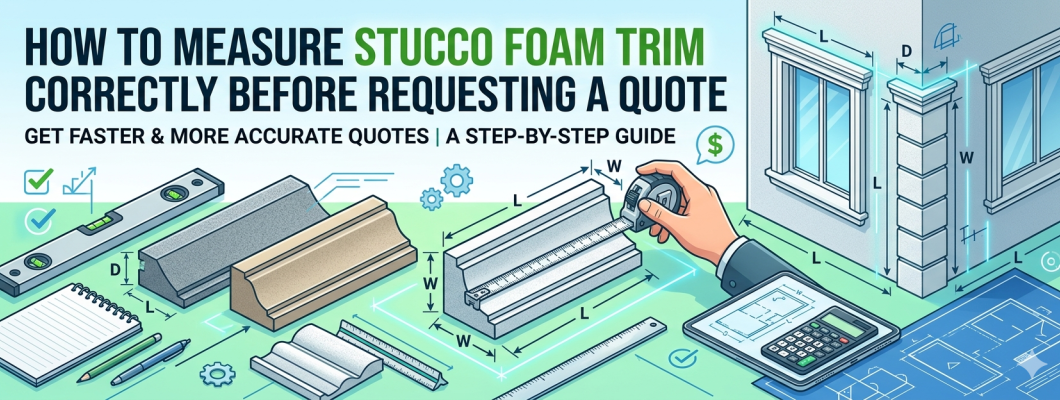
If you want a faster, more accurate quote for stucco foam trim, start with the measurements.
A few missing dimensions — or a mix-up like radius vs. diameter or feet vs. inches — can slow down the quoting process and create avoidable back-and-forth. Whether your project is in Sacramento, the Bay Area, Northern California, Southern California, Texas, Florida, Oregon, Washington State, or Las Vegas, clear measurements help move things forward faster.
Invicta Foam Products makes it easy for you to build your request online using the quotation cart. You can browse products, add the items you want priced, and then check out to submit your quote request along with your project and contact details.
Why Accurate Measurements Matter
Accurate measurements help speed up quoting and reduce mistakes before production begins.
They also make it easier to:
- get the right product recommendation
- confirm quantities and sizing
- compare standard and custom options
- reduce follow-up questions
- avoid ordering pieces that do not fit your project
When foam trim is one of the final visible details on a home or building, even a small measurement mistake can create a much bigger problem later.
How the Online Quote Process Works
Invicta Foam Products uses an online quotation cart instead of a single quote-request page.
That means you can browse products, add trim, sills, columns, shutters, corbels, and other foam details to the quotation cart, and continue building your request as you go.
Once you have added the items you want priced, you can proceed through checkout and submit your quote request with your contact information and project details. This gives the team a clearer picture of what you need and helps speed up review.
If your project includes custom pieces, unusual dimensions, or details that need clarification, it also helps to include measurements, photos, sketches, and notes with your submission.
Start With Basic Project Information
Before sending dimensions, gather a few project basics.
Helpful details include:
- your project city and state
- whether the job is new construction, a remodel, a repair, or a replacement
- where the foam will be used
- whether you need standard profiles or custom pieces
- whether you are matching an existing look or creating a new one
This gives the team useful context before reviewing the measurements.
How to Measure Straight Trim and Flat Stock
For straight trim, bands, and flat stock, keep the measurement list simple and organized.
For each piece or run, include:
- face height
- thickness or projection from the wall
- length of each run
- quantity
- any special edge detail, such as rounded or bullnosed edges
If several windows or doors use the same trim, make that clear in your request.
It also helps to group your measurements by area, such as:
- front elevation
- garage surround
- entry door
- second-story banding
That makes your request easier to review and price.
How to Measure Window Sills
Window sills usually need more than width alone.
For each sill, include:
- overall length
- projection from the wall
- face height or thickness
- quantity
- whether all sills are the same or if sizes vary by opening
If you are trying to match an existing sill profile, include a close-up photo and a simple side-view sketch if possible.
How to Measure Arches and Curved Pieces
Arches are one of the most common places for measurement mistakes.
For arches and curved trim, provide:
- overall height of the inner curve
- overall width of the inner curve
- the profile or shape you want used
- inner and outer radii, if available
- how the piece needs to curve
- quantity
This is where radius vs. diameter matters most. A simple wording mistake can create a very different final piece.
If you are not sure which measurement you have, include a sketch or photo with notes.
How to Measure Quoins
Quoins are usually L-shaped corner details, so they need a different set of dimensions than straight trim.
When requesting quoins, include:
- thickness
- height
- width
- quantity
- whether the pieces alternate left and right up the corner
If different corners use different sizes, list them separately.
How to Measure Columns, Caps, and Bases
For columns, the quote request should include both size and style.
Helpful information includes:
- column height
- diameter or width
- style, such as round, straight-sided, fluted, shaped, bellied, or tapered
- whether you also need bases and capitals
- quantity
- photos or inspiration references if you want a particular look
If the columns are being used at an entry, porch, gate, or commercial frontage, that context can also help.
How to Measure Custom Shapes
If your project needs something beyond a standard profile, send as much detail as possible.
For custom CNC-cut foam shapes, include:
- shape type or intended use
- full dimensions
- thickness
- piece length
- quantity
- sketches or marked-up photos
- CAD or DXF files, if available
If you are designing your own shape, it helps to provide it as a 2D closed spline at the size you want cut.
It is also helpful to keep in mind a few practical considerations from the manufacturing side. Thin areas can create problems, so custom shapes should generally avoid overly narrow sections. If a piece will be exposed to weather, slope and installation details may also matter.
For larger projecting pieces, or anything extending well out from the wall, support conditions may need to be considered as part of the review.
Common Measurement Mistakes That Delay Quotes
Most quote delays come from a few predictable issues.
Watch for these before sending your request:
- mixing up feet vs. inches
- confusing radius vs. diameter
- leaving out thickness or projection
- forgetting quantity
- sending photos without measurements
- combining standard and custom items in one unclear list
- not identifying special edge details or matching requirements
A quick review up front can save time and reduce back-and-forth later.
What to Send With Your Quote Request
A strong quote request usually includes more than just a list of dimensions.
Try to send:
- your project information
- measurements for each item
- quantities
- photos of the home, building, or installation area
- marked-up sketches
- CAD or DXF files for custom work, if available
- notes about whether you are matching existing trim or creating a new design
Even a simple hand sketch can be helpful if it is labeled clearly.
Standard Profiles vs. Custom Pieces
Not every project needs a fully custom shape.
Standard profiles are often the better fit when:
- you need straight runs in common sizes
- you want a simpler ordering process
- speed and repeatability matter most
Custom pieces may make more sense when:
- you are matching an existing profile
- your project includes arches or curves
- you need quoins, columns, corbels, brackets, or decorative details
- your design includes unique architectural features
Complete measurements make it much easier to determine which option fits your project best.
Quick Checklist Before You Submit
Before you submit your quote request, make sure you have included:
- project location
- type of project
- piece type
- height
- width
- projection or thickness
- length
- quantity
- radius or diameter details where needed
- photos
- sketches or files for custom items
A complete request helps the review process move much more smoothly.
Get a Faster, More Accurate Quote
Clear measurements help speed up the quoting process and make it easier to recommend the right foam trim, sills, arches, quoins, columns, and decorative details for your project.
When you are ready, you can add the products you want priced to the quotation cart, then proceed through checkout to submit your quote request and project details. If your project includes custom pieces or special conditions, including measurements, quantities, photos, and sketches will make the review process smoother and more accurate.
The more complete your information is at the start, the easier it is to review your request and help you move toward the right solution for your project.